A rough 12 step guide to successfully breeding corn snakes.
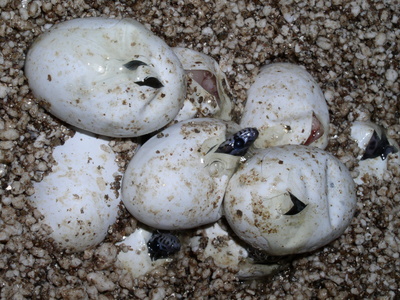
Corn Snakes (Pantherophis guttatus) are a great choice for anybody taking their first steps in snake breeding but it is important to make sure the potential newborns have a home to go to when hatched. This should be organised before attempting breeding otherwise you may find yourself overwhelmed with snakes for weeks or possibly months afterwards.
Step 1. Make sure the pair of Corn Snakes that you wish to breed are healthy, at least 2 years old and have been feeding well throughout the year. Brumation can be dangerous for an unhealthy snake. If in doubt visit the vet for a health check.
Step2. On November 1st stop feeding your snakes to allow them to digest and empty their guts prior to Step 3.
Step 3. Winter cooling (brumation). On November 15th start to reduce the temperatures in your Corn Snakes' vivarium by 4 degrees centigrade every 5 days until December 1st by which time temperatures should be maintained at 15-18 degrees centigrade until step 4. Although feeding has stopped, fresh water must still be available during the brumation period.
Step 4. On February 1st start to increase temperatures by 4 degrees centigrade every 5 days until normal maintenance temperatures are reached in mid February.
Step 5. The week following the return to normal temperatures you can resume their normal feeding schedule, although for the first week it may be better to offer them a few small food items rather than one large one. It is possible that the male won't accept much food, if any. This is not unusual during breeding season.
Step 6. After your female Corn Snake has shed her skin for the first time since being brought back to normal temperatures, introduce your male to the female Corn Snakes' vivarium for a few hours every 2 or 3 days until copulation has been observed at least twice to make sure.
Step 7. After copulation has taken place the snakes can be separated back in to their own vivariums.
Step 8. About 2 weeks after copulation prepare an egg laying box for the female. This can be a simple plastic tub with an access hole cut in the lid. The tub should be part filled with damp (not soaked) sphagnum moss or vermiculite. The tub must be large enough for the snake to fit inside comfortably and should be placed in the warm end of the vivarium. Eggs will hopefully be laid 3-5 weeks after mating. Corn snakes can lay between 5 & 50 eggs, although the average is around 20.
Step 9. Eggs should be removed from the females Corn Snakes' vivarium (being careful to keep them the the same way up.) and placed in a small plastic tub (with a few tiny air holes), half filled with moist vermiculite (approx 5 parts water to 6 parts vermiculite in weight). The eggs should be kept the same way up as they were laid and be buried in the vermiculite so that only the top 1/3 of the egg is showing. Put the lid on the box and place in an incubator such as the 'Lucky Reptile Herp Nursery'. If you're adventurous you could fashion a home made incubator with a small aquarium and your chosen heating equipment and thermostat, but bear in mind that all areas of the enclosure will need to be maintained constantly, night & day at the required incubation temperature of 27-30 degrees centigrade and humidity of 90-95%.
Step 10. Check on the eggs every few days to make sure the vermiculite is still sufficiently damp and that temperatures are maintained.
Step 11. After 2 to 3 months, if all goes well your new babies will start hatching. Leave newborn snakes to hatch on their own. It sometimes take up to a day for some newborns to emerge from the egg after they make the first cut in the shell with their egg tooth. Just let nature take its course and when all the Corn Snakes have hatched they can be moved into their own small separate accommodation with paper towel substrate and a small hide and water bowl.
Step 12. After their first shed your juvenile Corn Snakes should be ready for you to offer them their first pinkie.
Note: Corn Snakes will often breed without cooling them beforehand but the success rates and clutch sizes aren't usually as good.

copyright-petsnakecare.net 2012
